
Architecture
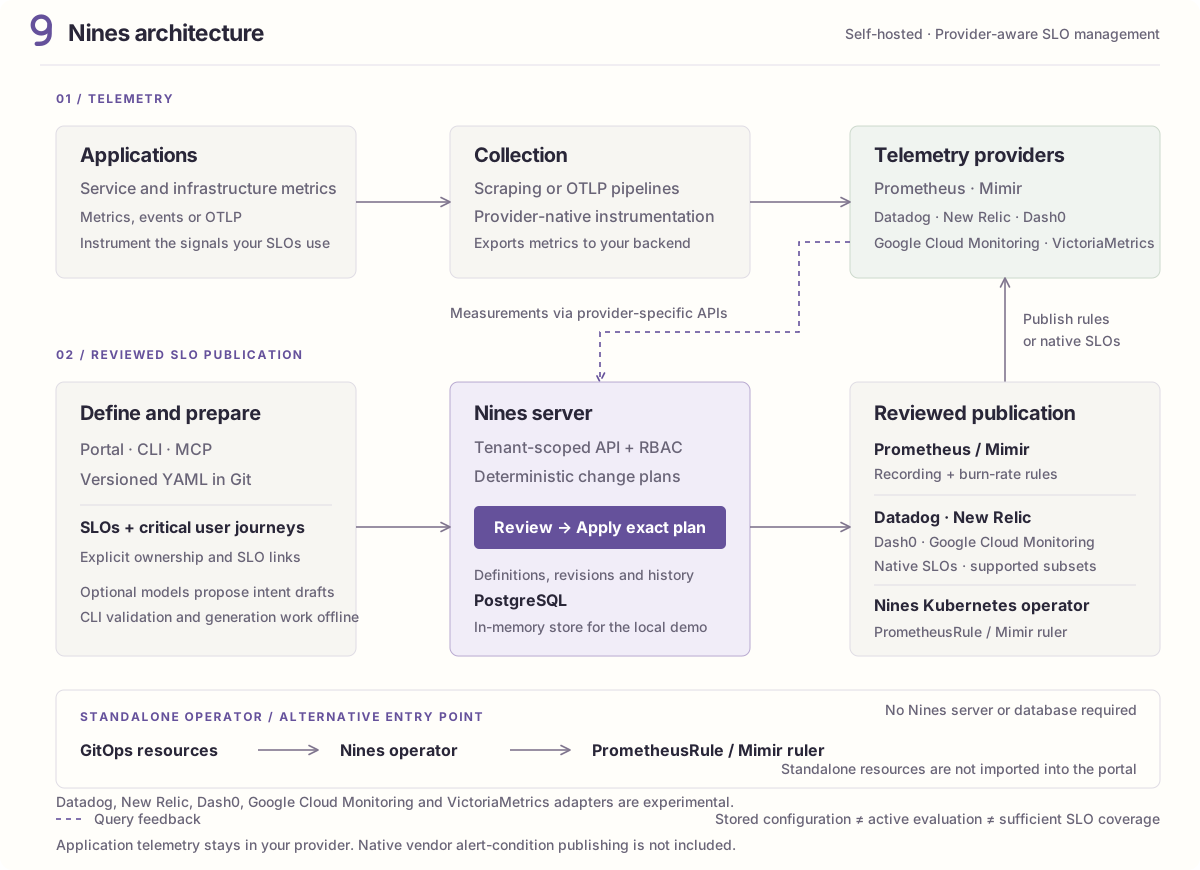
- Nines is a Go server with a React/shadcn/ui frontend embedded in the executable. PostgreSQL stores normal deployment data.
- The explicit demo uses isolated memory stores and synthetic data.
- Deploy one collecting server process for the MVP; distributed collector scheduling is not implemented.
- Telemetry stays in your observability backend. Nines reads provider-specific APIs for Prometheus, Mimir, Datadog, New Relic, Dash0, Google Cloud Monitoring and VictoriaMetrics.
- Datadog, New Relic, Dash0, Google Cloud Monitoring and VictoriaMetrics adapters are experimental.
- Prometheus/Mimir recording and burn-rate rules, reviewed native vendor SLO publication, and Nines attainment/alert evaluation are distinct capabilities.
- Datadog, New Relic, Dash0 and Google Cloud support native SLO publication within documented subsets. VictoriaMetrics currently supports collection only; native vendor alert creation is not included.
- Query languages, setup and live-test coverage differ by provider. See the provider capability matrix.
- The CLI shares validation, deterministic measurement compilation and recording-rule generation with the server.
- Offline commands do not start a server or load credentials.
- Connected operations use a fixed server and tenant, with exact revisions or digests for writes.
- The Go client and stdio MCP adapter use the same HTTP contracts.
| Path | Responsibility |
|---|---|
api/v1alpha1 | Shared versioned resource and operation types |
internal/model, internal/engine | Validation and SLI/SLO calculation |
internal/prometheus, internal/rules | Provider queries, recording and burn-rate rules |
internal/store | Memory/PostgreSQL resource and measurement storage |
internal/tenancy, internal/identity | Tenant boundaries, roles, sessions and provider identity |
internal/httpapi | Authenticated HTTP contracts and embedded UI |
cmd/server, cmd/nines, cmd/mcp | Server, Cobra CLI and stdio adapter |
client, skills | Go API client and bundled agent guidance |
web | UI source, tests and build configuration |
internal/intentflow, internal/investigation, reviewskills | Experimental bounded agent workflows |
internal/operator, cmd/operator | Standalone Kubernetes controller and GitOps adapter |
- The default resource is one self-contained SLO:
spec.measurementowns its metric, population, success criteria, scrape cadence and observation point alongside the target, window and policies.- Deterministic compilation derives provider selectors without creating another resource.
- The same contract works in portal, CLI, MCP and operator; intent workflows add human confirmation and reviewed changes.
- Explicit shared bindings and custom queries remain advanced alternatives.
- Each tenant selects an independently bound store, source map and rule destination.
- An owner can enable automatic rule reconciliation per source: saved SLO revisions, including approved intent apply and rollback, become the desired recording/alert rules.
- Prometheus uses a shared rule directory plus native reload, Mimir uses its ruler API, and operator mode publishes owned SLO CRs.
- Persistent pause/retry controls and separate runtime/output checks are described in automatic rule deployment.
- User input does not select database schemas, arbitrary provider URLs, credentials or Mimir organizations.
- Projects are metadata within a tenant, not independent security boundaries. Models cannot change the deterministic arithmetic.
- The Go module path is
github.com/ishantanu/nines.- Public SDK installation becomes available after the repository and version are published.
- The public source export is rooted in the platform alone; parent analysis files and other projects are excluded.